Our hands-on testing revealed that a proper blackjack pair split strategy reduces the house edge by up to 0.43% in standard games. The average blackjack player loses €1250 annually by mishandling pair-splitting decisions alone, so don’t be one of them. You’ll discover the mathematical reasoning behind each splitting decision and how to apply it confidently at the tables.
Split or Stand? 5 Essential Blackjack Pair Rules to Take Advantage Of
By Cosmin Brehoi
Table of contents
When Should a Blackjack Player Choose To Split Pairs?
In most casino blackjack variations, when players are dealt two pairs with the same value, there is an option to split the pair. Doing so means requesting an additional card each to get two separate hands. For each new hand, the bet gets doubled, and players now have two more chances to beat the dealer.
Keep in mind that before knowing the splitting strategy, you should know the difference between 3:2 blackjack and 6:5 blackjack. Knowing when it makes sense to split in blackjack will help you improve the overall quality of play. So, let’s look at some critical moments when you should go for the option. Note that following these strategies does not necessarily mean you’ll win every time, but there’s a higher possibility of winning in the long run. To increase your chances, explore blackjack variations at top live online casinos that offer real-time gameplay and other type of odds. 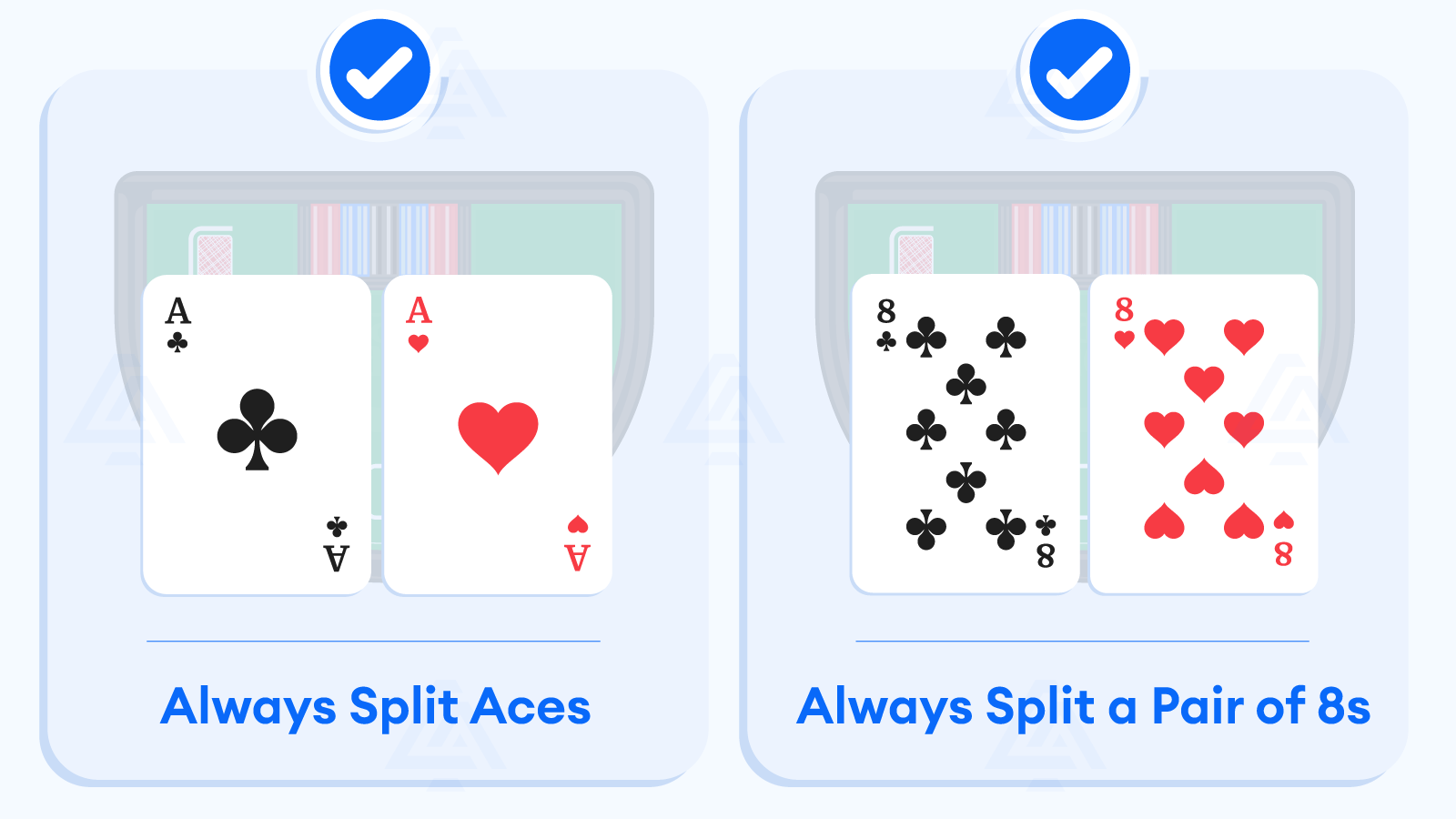
Always Split Aces
An ace is the only card in the deck with two different values due to the unique flexibility of being counted as 1 or 11 points. Since cards with a value of 10 are more in the deck, splitting a pair of aces gives you two chances to hit 21. If you choose not to split your ace, the house edge increases, and you’re likely to lose the hand because drawing a ten will bring the value of your hand to 12, as both aces will be counted as one each. Additionally, we advise you to consider blackjack insurance in this scenario, especially if the live dealer shows an ace.
Always Split a Pair of 8s
Splitting when you get a pair of eights is simply the logical thing to do, as not splitting leaves you with a risky hand worth 16 points. With this total card value, there isn’t much you can do to keep yourself from going bust. If, for any reason, you still decide to hit and take a third card, the risk of your blackjack hand going over 21 is very high. You can enhance your approach by using strategies like the Martingale system to manage your betting strategy effectively
Never Split These Hands When Playing Blackjack
We know by now that splitting can help lower the house edge in the game of blackjack, and many players would always take that route to improve their gameplay. Nevertheless, some instances require you to do the opposite, especially when given blackjack cards with values of 2 through 7. Here are some of the cards you should never split in blackjack: 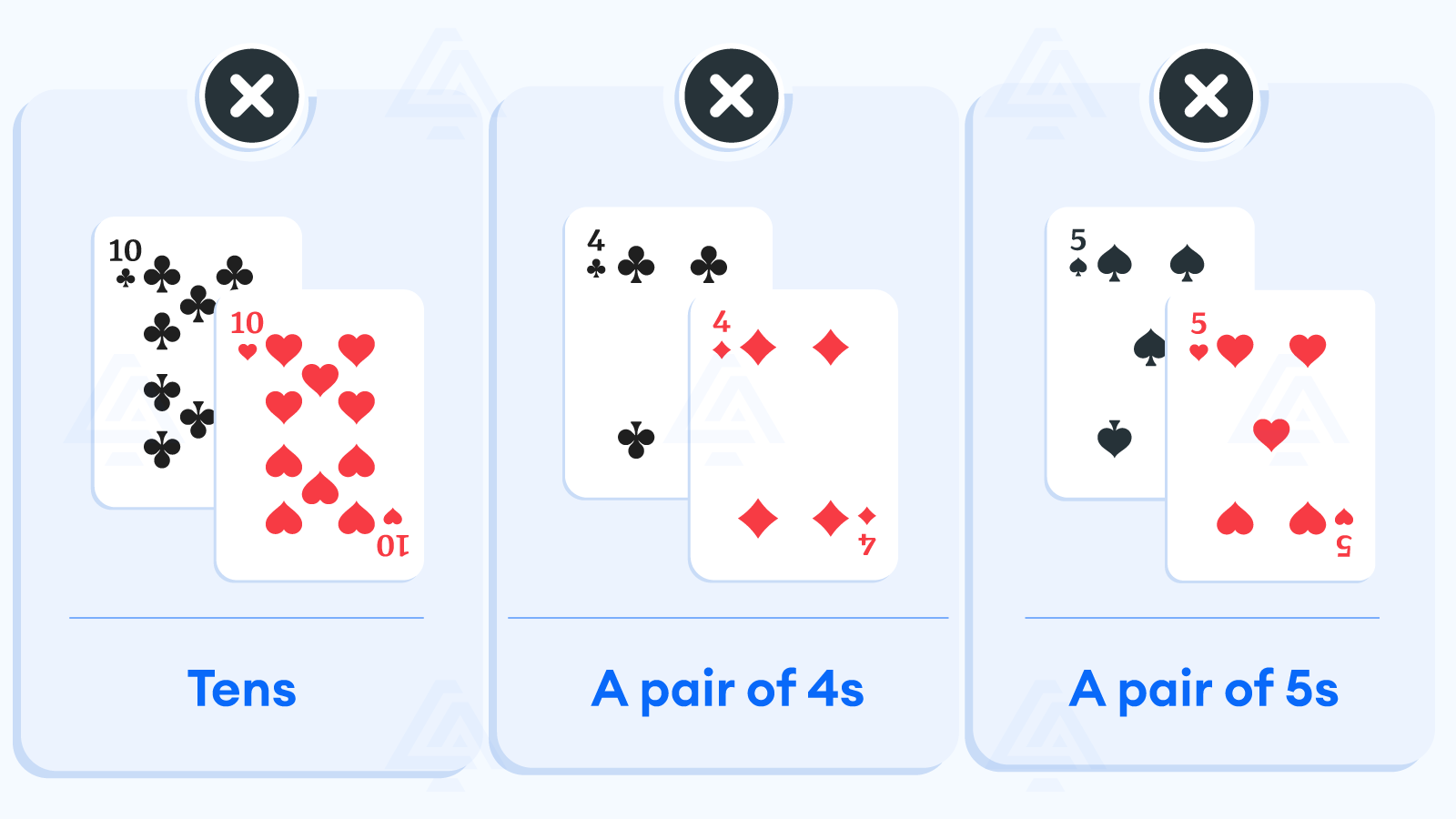
-
Never Split Tens
While it’s advisable to split ace, you must never split 10s as it can be counterproductive to your hand. A pair of 10s equals a score of 20, which is a strong hand. The possibility you’ll have better odds with an extra card after splitting tens is unlikely.
-
Avoid splitting a pair of 4s
When you have a pair of fours, it is impossible to go over 21 with the next hit. The most you can get from receiving an extra two cards is a total value of 19. Assuming you still make the decision to split, only three cards from the deck can make your current hand better than the original split pair.
-
Never split 5s
Splitting 5s is never a good idea, regardless of the deck of cards you’re playing against or what total the dealer must hit. Depending on whether the dealer has a 2 through 9 on their up-card, you should only double down or take a hit. The alternative is to split when the dealer has a ten, nine, or an ace and then double down after splitting. Doubling after a split lets you increase the stakes on whichever half of your split you desire.
Split/Stand: Different Ways a Dealers Up Card Affects You
The previous splitting tips we recommend applying at a blackjack table involve the cards you receive. However, the dealer’s card can also influence your decision to split. Highlighted below are the dealer up-cards that should impact your decision on whether to split or not in blackjack:
- The dealer shows a 2-6 : You should split your 2s and 3s in addition to any pairs of 6s, 7s, and 9s you might have. The exception is if you hold a 4-4 pair, which would simply hit if the dealer has a two, three, or four.
- The dealer shows a 7 : Only split if you have a 2-2, 3-3, and 7-7; hit if you have a 4-4 and 6-6; stand if your card pair is 9s. If you’re wondering why you must stand when you have a 9-9, it’s because a total of 18 can hold well against the dealer’s 7.
- The dealer shows an 8 or a 9 : In this situation, you should split pairs of 9s if it’s what you have in your hand. For a card pair of 2s, 3s, 4s, 6s, and 7s, you should draw another card.
Our Verdict: Make Considerations Before You Split Blackjack Pairs
In live blackjack games, pair splitting is a great strategy to incorporate, especially when you need to split pairs of aces and 8s to beat the house. Before doing this, you should consider how much you have in your bankroll to know if you can afford the eventualities or avoid the strategy altogether. Splitting would typically require you to double the bet on some hands, so if you’re already down to your final few chips, perhaps reducing your stake is the better strategy. Learn about the strategy deviations presented by our experts by checking out our designated page!
Meet Our Experts

Author
Cosmin Brehoi
Author & Editor
As CasinoAlpha's Author & Editor since June 2021, Cosmin Brehoi creates casino reviews, bonus evaluations, and educational guides that empower players. His portfolio features 150+ guides and articles on licensing standards and responsible gaming, plus 100+ casino reviews and bonus codes.

Recommended Articles

Free Bonus Abuse
Free bonus abuse accusations can have serious consequences beyond just losing your current balance. Our analysis of Irish gambling regulations reveals that casinos share player data, potentially blacklisting you across multiple operators for up to 5 years. The legal definition of bonus abuse encompasses more activities than most players realize, including seemingly innocent actions like strategic game selection.
By Adela Mariuta

Most Popular Casino Games in Ireland
In Ireland, slots are the most popular casino game, while table games and live casino games are the close second and third gambling preferences. We’ve defined these games and explored what features make them so popular.
By Anca Iamandi

Is Online Gambling Legal in Ireland?
In our newest legal guide, you will learn exactly whether online gambling is legal in Ireland. You will find out about the GRAI, the offshore casino’s status and more. Read on and learn!
By Adela Mariuta

European Roulette vs French Roulette
A 2.7% house edge in European roulette drops to 1.35% in French roulette with La Partage, basically cutting losses by half on even-money bets. That’s not a drastic difference, it’s mathematical. This guide breaks down how the French version empowers strategic players with second-chance mechanics, different wheel logic, and VIP-level bet types. If you’re chasing better odds, this is your roadmap.
By Anca Iamandi

Pay attention to the casino bonus terms
A €100 casino bonus sounds great until you find the 45x wagering and 5-day expiry buried in the terms. After testing dozens of offers, I’ve seen how quickly players lose winnings due to unclear rules. This blog decodes the fine print so you’ll know what’s fair, what’s risky, and how to use bonus money wisely.
By Adela Mariuta
Most Read
1.